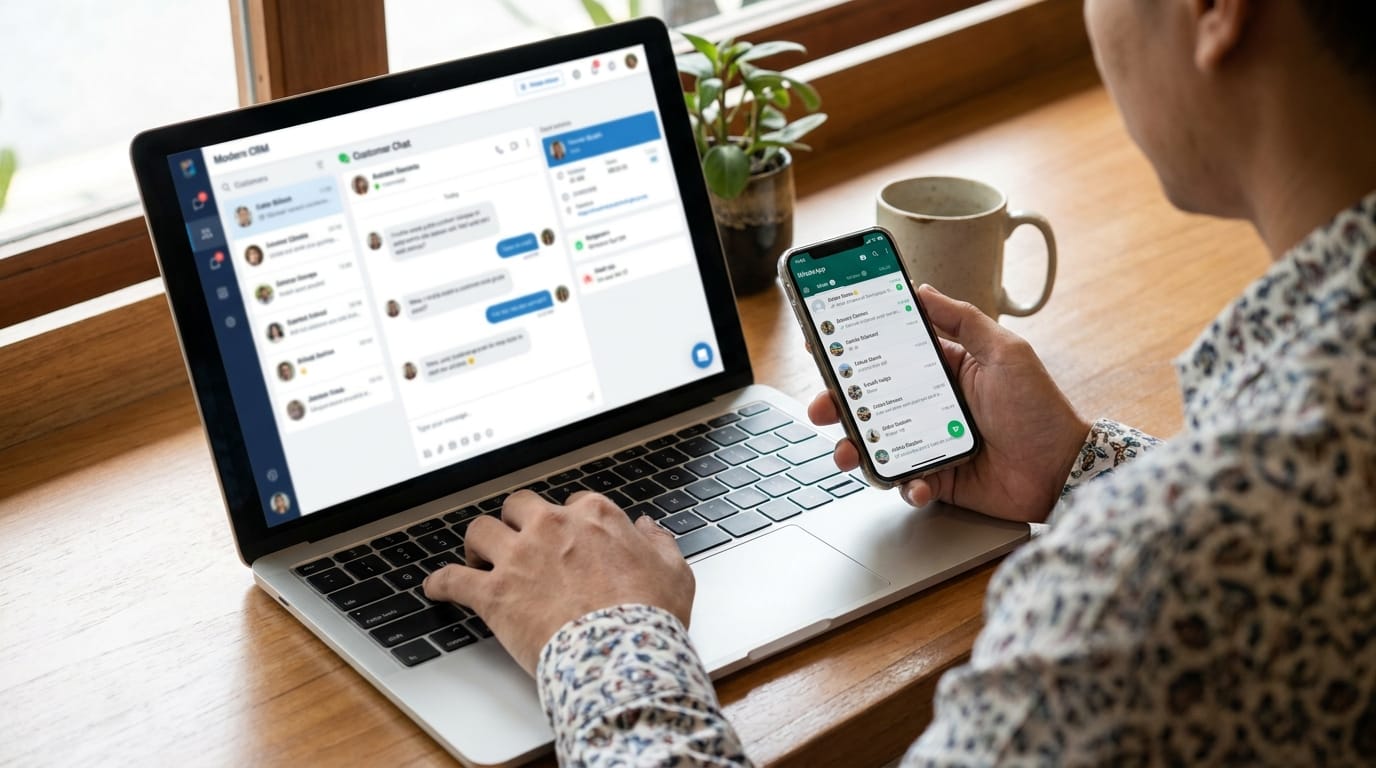
- Best Overall Free CRM: HubSpot offers a powerful free-forever plan with extensive marketing automation features, making it ideal for SMEs starting their CRM journey.
- Best for Affordability & Localisation: Zoho CRM provides the most cost-effective paid plans at scale, full Bahasa Malaysia support, and native WhatsApp integration, suiting budget-conscious businesses.
- Critical Feature for Malaysia: Native WhatsApp Business API integration is non-negotiable. It allows teams to manage conversations directly within the CRM, a crucial function since 65% of Malaysian consumers prefer WhatsApp for business communication.
- The Spreadsheet Problem: Relying on spreadsheets or WhatsApp chats alone for lead management is a major risk. A staggering 78% of Malaysian SMEs still use this method, leading to an estimated 30% loss of leads from missed follow-ups.
A customer relationship management (CRM) system is software that helps businesses organise, track, and manage all interactions with current and potential customers. For a Malaysian SME, the best CRM software is typically HubSpot for its powerful free tier or Zoho CRM for its affordable pricing and strong local support. The deciding factor is often native WhatsApp Business API integration, a critical feature for engaging with the local market effectively.
If your sales process lives in a combination of Excel spreadsheets, WhatsApp group chats, and personal notebooks, you are leaving money on the table. This disorganised approach makes tracking leads, following up consistently, and understanding your sales pipeline nearly impossible. A dedicated CRM system centralises this data, automates repetitive tasks, and provides the insights needed to grow sustainably in a competitive market.
What is CRM? (And Why WhatsApp Isn’t Enough)
Customer Relationship Management (CRM) is a strategy and a technology for managing a company’s relationships and interactions with customers and prospects. A CRM system helps organisations stay connected to customers, streamline processes, and improve profitability. It stores customer contact information, accounts, leads, and sales opportunities in one central location.
Many Malaysian SMEs believe they use WhatsApp as their CRM. While it is an essential communication tool, it is not a CRM. WhatsApp lacks the structure to track a lead’s journey, automate follow-ups, or provide analytics on sales performance.
Conversations get lost, follow-ups are forgotten, and there is no single source of truth for customer data.
Signs Your SME Needs a CRM System
Transitioning from manual methods to a structured system becomes necessary when growth exposes the weaknesses of spreadsheets. The signs are often clear and directly impact revenue and efficiency.
- Leads are falling through the cracks: You receive enquiries via website forms, social media, and WhatsApp, but there is no central system to assign and track them.
- Follow-ups are inconsistent: Salespeople forget to contact prospects at the right time because they lack automated reminders and a clear task list.
- Reporting is a manual nightmare: Creating a weekly sales report requires manually compiling data from multiple spreadsheets and chat logs.
- Customer history is scattered: You have no single view of a customer’s past purchases, enquiries, or support issues, making personalisation difficult.
- Onboarding new salespeople is slow: It takes weeks to get a new hire up to speed because all customer knowledge lives in the heads of existing team members.
Top 5 CRM Malaysia Options: An Honest Comparison
Choosing the right CRM software in Malaysia depends on budget, team size, and technical needs. Below is a comparison of the most popular options for local SMEs, with pricing converted to Ringgit Malaysia (RM) for clarity.
| CRM Name | Best For | Free Tier Price (RM) | Paid Tier Price (RM) | Bahasa Malaysia Support | Native WhatsApp API | Learning Curve |
|---|---|---|---|---|---|---|
| HubSpot CRM | Marketing automation + free tier | Free | ~RM 120/user/mo (Starter) | Partial | Yes (via add-on) | Steep |
| Zoho CRM | Affordable at scale + BM support | Free (up to 3 users) | ~RM 45/user/mo (Standard) | Full | Yes (native) | Moderate |
| Freshsales | SME sales teams + clean UI | Free (up to 3 users) | ~RM 75/user/mo (Pro) | Partial | Yes (native) | Low |
| Monday CRM | Visual agencies + easy learning | Free (up to 2 users) | ~RM 100/user/mo (Basic) | Partial | Yes (via integration) | Low |
| Salesforce | Powerful + enterprise features | Free (up to 10 users) | ~RM 250/user/mo (Essentials) | Full | Yes (native) | Steep |
Beware the “free CRM” trap. While HubSpot’s free plan is excellent, essential features like advanced WhatsApp integration are paid add-ons. Always calculate the total cost of the features your business truly needs.
Prioritise Native WhatsApp Integration
For any business operating in Malaysia, effective WhatsApp communication is not optional. However, not all CRM “integrations” are equal. It is vital to distinguish between a simple link and a true API integration.
Level 1: Click-to-Chat Links
This is the most basic form. The CRM stores a customer’s number, and clicking it opens a new chat in WhatsApp Web or the desktop app. The conversation itself happens outside the CRM, and no data is captured automatically. This adds little value over a spreadsheet.
Level 2: Native API Integration
This is the goal. The WhatsApp Business API connects directly to the CRM, allowing your team to send and receive messages from within the CRM interface. The entire conversation history is automatically logged against the customer’s contact record. This provides a complete view of all interactions, enables team collaboration on a single number, and allows for automation.
How to Choose the Right CRM for Your Business
Selecting the best CRM Malaysia offers requires looking beyond features and matching the tool to your specific operational reality.
Business Model (B2B vs. B2C): B2B sales cycles are often longer and involve multiple decision-makers. A CRM like HubSpot or Salesforce is strong here. B2C businesses with high-volume, shorter sales cycles might favour Zoho or Freshsales for their streamlined lead management.
Team Size and Scalability: A free plan from Zoho or Freshsales is perfect for a team of 1-3. If you anticipate hiring more salespeople, analyse the per-user cost of the paid plans. Zoho often presents the most affordable path to scale.
Technical Comfort: If your team is not tech-savvy, a CRM with a steep learning curve like HubSpot or Salesforce can hinder adoption. Monday CRM and Freshsales are known for their intuitive, user-friendly interfaces.
Ecosystem and Integrations: Consider the other tools you use. Does the CRM connect easily to your accounting software (critical for Malaysia’s e-invoicing mandate), email marketing platform, or e-commerce store?
Migrate from Spreadsheets to CRM in 5 Steps
Making the switch can feel daunting, but a structured approach simplifies the process.
Clean Your Data: Before importing, standardise your spreadsheet. Ensure consistent formatting for names, phone numbers (with country codes), and email addresses. Remove duplicate entries.
Define Your Sales Pipeline: Map out the stages a lead goes through, from “New Enquiry” to “Proposal Sent” to “Won/Lost”. Replicate these stages in your new CRM.
Perform a Test Import: Export a small sample (10-20 contacts) from your spreadsheet as a CSV file. Import this sample into the CRM to ensure all data fields map correctly.
Import All Data: Once the test is successful, import your complete contact and lead database.
Train Your Team: Conduct a hands-on training session. Focus on the core daily tasks: adding a new lead, updating a deal stage, and logging a conversation. Mandate that all lead activity must happen within the CRM from day one.
Real Results: Recovering Leads with a CRM in Malaysia
The impact of a proper CRM system is not just theoretical. A mid-sized F&B chain in the Klang Valley provides a powerful example. The business was losing track of catering enquiries that came through its single WhatsApp number.
By implementing Zoho CRM with its native WhatsApp integration, they achieved three key wins. First, all incoming chats were automatically captured as new leads. Second, leads were assigned to salespeople in a round-robin fashion, ensuring fast responses.
Third, automated reminders were set for follow-ups. The result was a 30% recovery of previously abandoned leads within three months.
This shift from a chaotic inbox to a structured system demonstrates the direct revenue impact of adopting the right CRM in Malaysia.
A well-implemented CRM is the central nervous system for a growing SME. It transforms messy data into actionable intelligence, ensures no customer is forgotten, and builds the foundation for scalable growth.
The core principle is simple: If an interaction is not in the CRM, it did not happen.
For Malaysian SMEs ready to move beyond spreadsheets and unlock their full sales potential, adopting a CRM is the most critical step. If you need help selecting and implementing the right platform for your business, the contact our team at OpenMinds Group is available to discuss bespoke solutions.
See how this works in practice in our OpenMinds case studies.
Sources
- Outrightcrm: “Top 6 CRM Software for Malaysian SMEs (2026 Edition)” (2026)
- Hashmicro: “15 Best CRM Software in Malaysia for (2026) – HashMicro” (2026)
- Peppercloud: “Best CRM Software in Malaysia | Pepper Cloud” (2026)
- Raiontech: “Why Malaysian SMEs Are Ditching Spreadsheets for CRM in 2026 …” (2025)
- Exabytes: “How to Choose Best CRM Software for Malaysia Small Business” (2022)
- Tecsa: “Best Business Software for SMEs in 2026 | TECSA” (2026)
- Odoo: “Top 5 ERP Systems for Malaysian SMEs in 2026 | E-invoice Ready” (2026)
Want to put this into practice?
Our team builds and optimises MarTech stacks for enterprise brands across Malaysia and APAC.