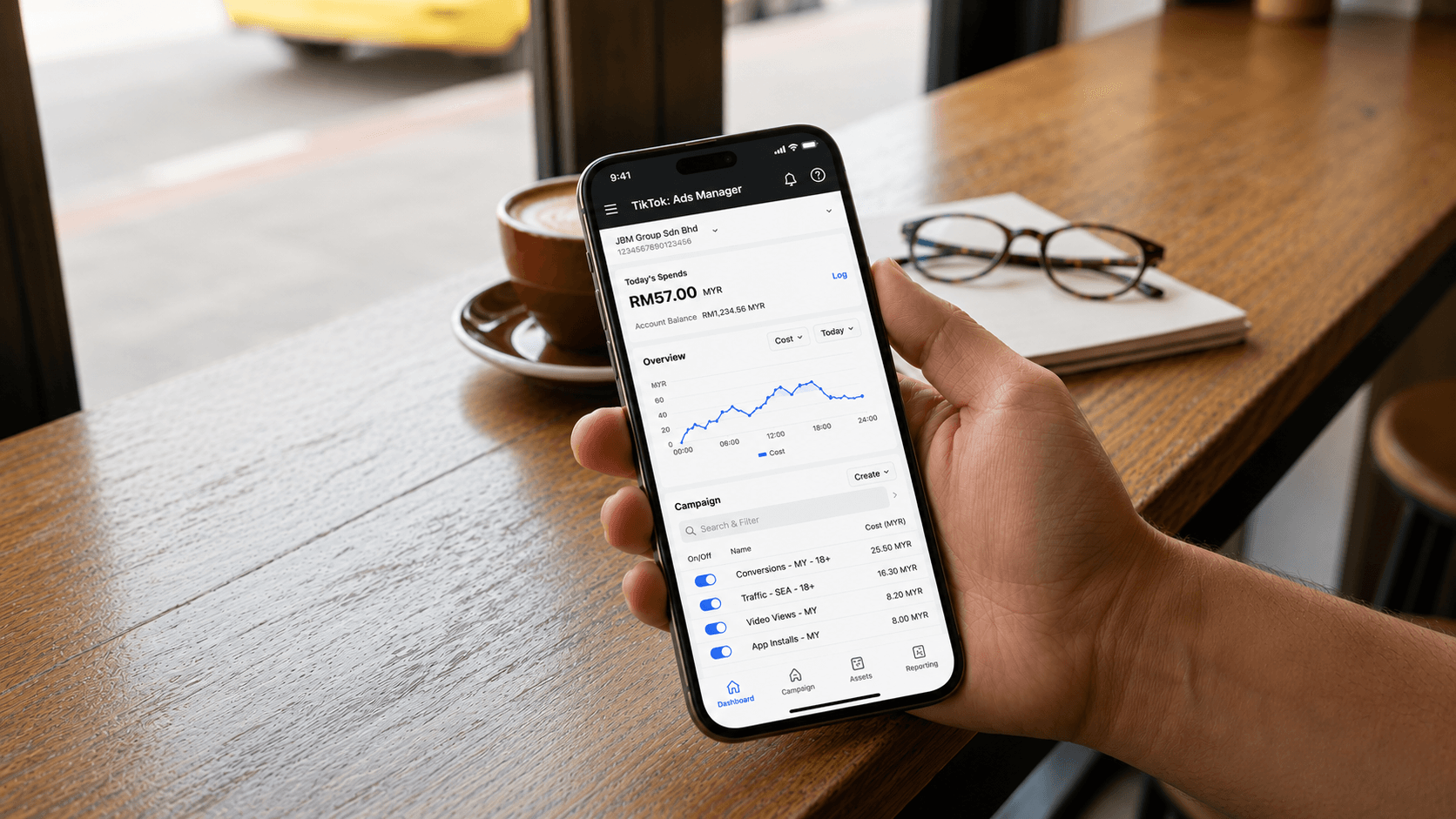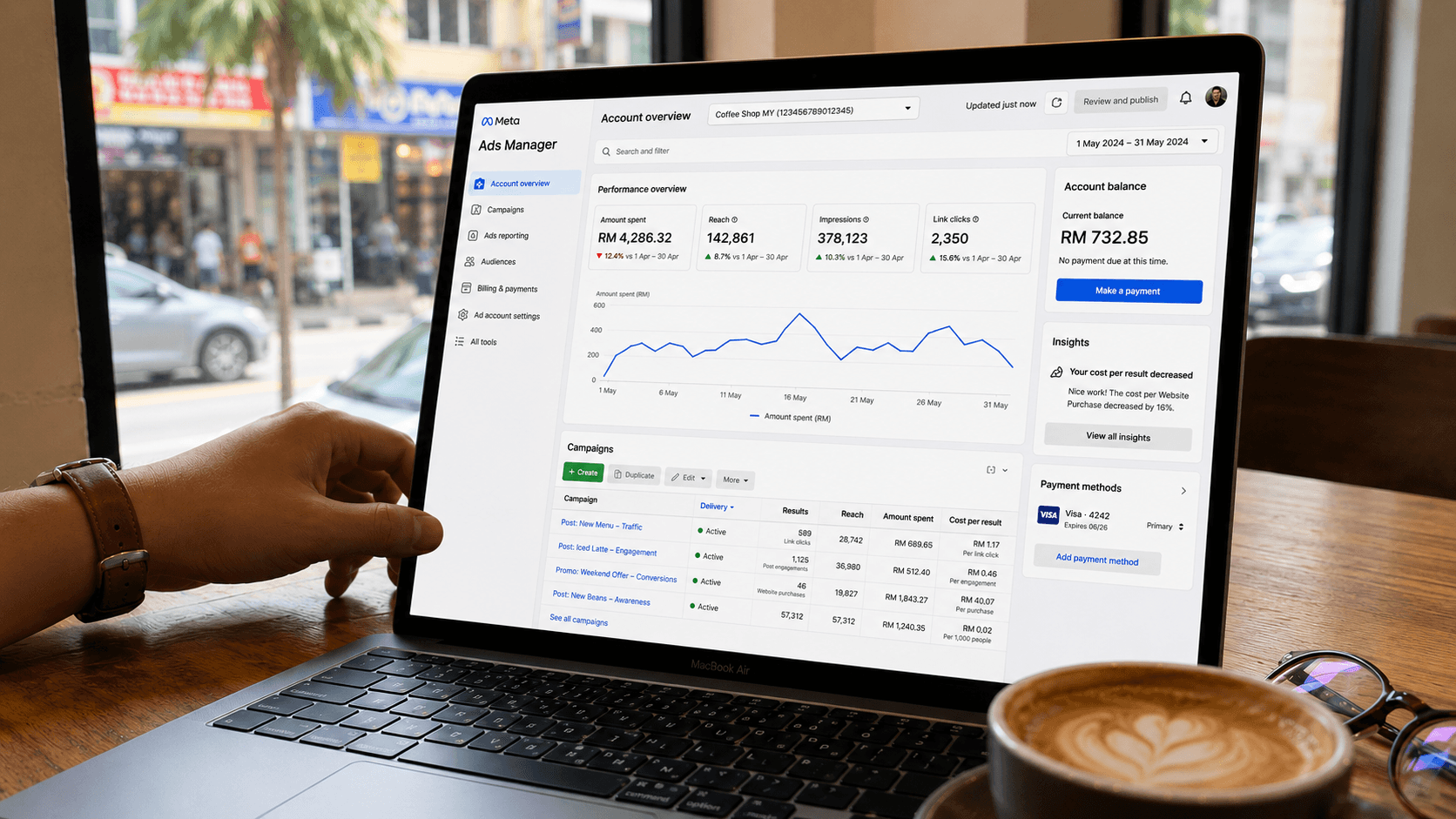

- Platform Costs Vary by Goal: Google Ads commands the highest cost for high-intent searches (legal, medical), while TikTok offers the lowest Cost Per Mille (CPM) for broad awareness campaigns.
- Industry Is a Key Cost Driver: The average Cost Per Click (CPC) on Google Ads can range from RM2 for e-commerce to over RM25 for competitive legal services, making industry benchmarks critical for budget planning.
- Minimum Budgets Are Essential: Meaningful data for optimisation on platforms like Google Ads requires a minimum monthly spend of RM1,500 to RM3,000. Budgets below this level often fail to generate statistically significant results.
- Metrics Beyond CPC Matter: Focusing solely on CPC is a mistake. Mature digital strategies prioritise metrics like Cost Per Lead (CPL) and Return on Ad Spend (ROAS) to measure true business impact.
The digital ads cost in Malaysia is not a single figure but a dynamic calculation influenced by platform, industry, and strategic objective. As organisations plan their 2026 marketing budgets, understanding the cost structures of Google, Meta, and TikTok is fundamental to allocating resources effectively and achieving a positive return on investment.
This analysis moves beyond surface-level averages. It provides enterprise leaders with the benchmarks and strategic frameworks needed to compare platforms, forecast spending, and justify digital advertising investments based on performance data specific to the Malaysian market.
Benchmark Costs Across Platforms
A foundational step in budget allocation is understanding the typical cost metrics for each major platform. While figures fluctuate based on audience targeting, creative quality, and seasonality, established benchmarks provide a reliable starting point for any discussion on digital ads cost in Malaysia.
The table below outlines the average costs for key performance indicators across Google Ads, Meta (Facebook and Instagram), and TikTok Ads in 2026.
| Metric | Google Ads | Meta (FB/IG) | TikTok Ads |
|---|---|---|---|
| Avg. CPC (RM) | RM2.50 (RM1–5 typical) | RM0.30–RM3.00 | RM0.50–RM2.00 |
| Avg. CPM (RM) | N/A (search-focused) | RM8–RM35 | RM5–RM15 |
| Avg. CPL (RM) | Varies; RM15–RM100+ | RM8–RM80 | Varies; RM10–RM60 est. |
| Min. Daily Budget (RM) | RM30–RM50 (awareness) | RM30 | RM20 (ad group) |
Use these figures as a baseline. A high CPC is not inherently bad if it generates a high-value lead. Conversely, a low CPM is a vanity metric if it fails to drive conversions.
Analyse Google Ads Industry Costs
On Google Ads, competition is the primary factor driving costs. High-value industries where a single conversion can be worth thousands of Ringgit, such as legal services or property, face significantly higher CPCs. This is a critical factor when evaluating the overall digital ads cost in Malaysia.
Organisations in these sectors must budget accordingly and focus intensely on conversion rate optimisation to ensure a viable CPL. The following table details estimated CPCs and practical monthly budgets for various industries in Malaysia.
| Industry | Avg. CPC (RM) | Practical Monthly Budget (RM) |
|---|---|---|
| Legal / Immigration | RM18–45 | RM4,500–10,000+ |
| Dental / Medical | RM15–35 | RM3,500–8,000 |
| Education / Tuition | RM12–28 | RM3,000–7,000 |
| Property / Real Estate | RM8–20 | RM2,500–6,000 |
| E-commerce / Retail | RM2–6 | RM1,500–3,500 |
Set a Viable Minimum Budget
Launching campaigns with insufficient budget is a common cause of failure. Without enough data, platform algorithms cannot effectively optimise for performance, and marketers cannot make informed decisions.
Google Ads: The Data Threshold
For Google Ads, a monthly budget below RM1,500 is generally insufficient to gather the click and conversion data needed for proper optimisation. A more practical starting point for a small to medium-sized campaign is RM1,500 to RM3,000 per month.
Meta & TikTok: The Daily Minimums
Meta and TikTok have lower technical minimums, with TikTok allowing ad group budgets as low as RM20 per day. However, to achieve meaningful reach and frequency, a daily spend of at least RM50 is a more realistic starting point for testing campaigns.
Re-evaluate TikTok’s Role in 2026
The perception of TikTok as merely a low-cost, low-intent platform is outdated. For many Malaysian e-commerce and B2C brands, its cost structure presents a compelling alternative to Meta. TikTok’s average CPM often comes in lower, ranging from RM5 to RM15 compared to Meta’s RM8 to RM35.
However, its effectiveness for high-consideration B2B or lead generation campaigns can be more variable. While its CPC is competitive, the lead quality may not always match that from high-intent platforms like Google Search. A balanced strategy often involves using TikTok for top-of-funnel awareness and Meta or Google for mid-to-lower-funnel conversions.
Structure Campaigns by Business Objective
Effective budget management requires aligning spend with specific, measurable goals. A single campaign cannot efficiently serve awareness, lead generation, and sales objectives simultaneously.
Awareness: Prioritise metrics like CPM and reach. TikTok and Meta’s video ad formats are often the most cost-effective channels for this stage.
Consideration: Focus on CPC, click-through rates (CTR), and landing page views. Google Display and Meta traffic campaigns are suitable here.
Conversion: The most critical stage, measured by CPL or ROAS. Google Search and Meta conversion campaigns are the primary drivers for this objective.
By structuring campaigns this way, organisations can allocate budget with precision and hold each channel accountable to the metrics that matter most for its role in the customer journey.
Move Beyond Simple CPC Metrics
While CPC is a useful diagnostic metric, it does not measure business success. The most sophisticated marketing teams build their budget models around metrics that connect directly to revenue.
- Cost Per Lead (CPL): This measures the efficiency of lead generation efforts. In Malaysia, Meta CPLs can range from RM8 for simple form fills to up to RM200 for high-value sectors like property or insurance.
- Return on Ad Spend (ROAS): This is the ultimate measure of profitability, calculating the revenue generated for every Ringgit spent on advertising. Tracking ROAS requires a robust analytics and attribution setup.
Focusing on these advanced metrics allows for more strategic conversations about budget. It shifts the question from “How can we lower our CPC?” to “How can we invest more to acquire profitable customers?” For guidance on implementing advanced tracking, contact our team.
Conclusion
Determining the digital ads cost in Malaysia for 2026 requires a multi-faceted analysis, not a simple price list. Leaders must evaluate costs within the context of their specific industry, business objectives, and desired outcomes. Google remains the premium choice for capturing intent, Meta provides versatile targeting, and TikTok offers efficient reach.
A successful strategy rarely relies on a single platform.
True cost efficiency is achieved not by spending the least, but by investing where returns are greatest.
A clear understanding of these platform dynamics is the first step toward building a resilient and profitable digital advertising portfolio. The experts at our services can help your organisation develop a bespoke media plan grounded in Malaysian market data.
Sources
- Marketing Lancers – Analysis of TikTok advertising costs and agency rates in Malaysia
- OneDigital Development – A comparative report on Meta Ads versus TikTok Ads performance in Malaysia
- MediaPlus Digital – Guide to TikTok advertising costs for businesses in Malaysia
- OpenMinds Resources – In-depth guide on Google Ads costs for Malaysian SMEs
- Fixgure – 2026 forecast and analysis for Meta Ads costs in the Malaysian market
- Zenweb – Overview of TikTok marketing pricing and packages for SMEs in Malaysia
- XWORK – A 2026 guide to Google Ads costs in Malaysia with industry-specific CPC data
- Fixgure – Comprehensive breakdown of Google Ads costs and budgeting for 2026 in Malaysia
Want to put this into practice?
Our team builds and optimises MarTech stacks for enterprise brands across Malaysia and APAC.