Malaysia captured 32% of all Southeast Asia AI funding between mid-2024 and mid-2025. USD 759 million. Four global tech giants committed over USD 15 billion to build AI and cloud infrastructure here. By every headline measure, Malaysia is a digital economy on the move. Yet only 12% of Malaysian SMEs had adopted AI in any meaningful capacity as of 2024. That tension is what this report is actually about.
This is not an argument for why Malaysian businesses should digitalize. That case has been made. This is a status check on where Malaysia actually stands in 2026, sector by sector, with the data to back it.
AI funding share: Digital in Asia, Malaysia Digital Market Overview 2026, May 2026. SME AI adoption rate: MDEC data cited in Industry Chatter, Malaysia Economic Outlook 2026, March 2026.
Sources: Digital in Asia, May 2026; Mordor Intelligence, Malaysia Digital Transformation Market, January 2026; MDEC Digital Investment Statistics 2024.
5G Coverage: Milestone Reached, Speed Problem Is Real
Malaysia’s 5G coverage headline of 82.4% tells you where the signal exists. It does not tell you what happens when 28.7 million subscribers try to use it simultaneously. Speeds fell 46% as adoption scaled. Coverage and capacity are not the same problem.
By the end of 2025, Malaysia’s 5G network reached 82.4% of populated areas, with subscriptions growing from 4.6 million in November 2023 to 28.7 million by November 2025. A six-fold increase in 18 months. On the coverage metric, the rollout succeeded ahead of schedule.
The structural issue emerged from the model itself. Malaysia’s first 5G network runs through Digital Nasional Berhad (DNB), a single wholesale infrastructure provider. Every major telco (CelcomDigi, Maxis, and YTL’s Yes) purchases capacity from the same shared pipe. When subscriber numbers tripled in 2024, that shared infrastructure could not scale proportionally. Measured 5G speeds fell 46% during 2024 to 2025, according to network analytics tracking the period.
5G subscription growth and speed decline: Tech Wire Asia, Malaysia 5G Reality Check, January 2026.
The government’s response is Malaysia’s second 5G network, awarded to U Mobile in November 2024. U Mobile launched its Ultra5G network in August 2025, built on standalone (SA) architecture with 5G-Advanced capabilities from day one, using Huawei and ZTE infrastructure. U Mobile is targeting 80% coverage of populated areas by the second half of 2026, though industry analysts consider the timeline ambitious given the buildout scale required.
Coverage by state shows significant disparity. As of early 2026, Putrajaya leads at 99.7% coverage, followed by Kuala Lumpur at 90.9%, Labuan at 90.8%, Penang at 82.3%, and Selangor at 70.9%. East Malaysia and rural peninsular states lag considerably.
State-level coverage figures: SAMENA Council, U Mobile 5G coverage update, 2025. U Mobile rollout target: RCR Wireless, September 2025.
For Malaysian enterprises planning 5G-dependent applications such as edge computing, real-time analytics, and high-bandwidth operations, the dual network rollout matters more than the coverage number. U Mobile’s SA architecture supports network slicing and ultra-low latency deployments that the DNB non-SA model does not. Businesses in Klang Valley and Penang can begin scoping enterprise 5G applications now. Businesses outside these corridors should plan around LTE with 5G migration built into 18-month roadmaps, not 6-month ones.
AI in Malaysia: The Infrastructure Is Here, the Adoption Depth Is Not
Malaysia attracted USD 15 billion in AI and cloud infrastructure commitments from four global tech giants. It built 690 megawatts of data centre capacity in 18 months. It captured 32% of Southeast Asia’s AI investment. Approximately 73% of Malaysian businesses using AI are still running basic chatbots and simple predictive tools. The infrastructure and the depth of adoption are on completely different timelines.
The investment numbers are genuinely significant. Between H2 2024 and H1 2025, Malaysia absorbed USD 759 million in AI-related funding, representing 32% of the entire Southeast Asian AI investment pool. Four global technology companies made direct commitments to Malaysian infrastructure: Microsoft committed USD 2.2 billion, Google USD 2 billion, the NVIDIA and YTL partnership announced USD 2.36 billion focused on data centres and AI computing, and Oracle committed USD 6.5 billion. The combined commitment from these four alone exceeds USD 15 billion.
Investment figures: Digital in Asia, Malaysia Digital Market Overview, May 2026.
Physical infrastructure responded accordingly. Malaysia’s data centre capacity grew from 120 megawatts in 2023 to 690 megawatts by mid-2025. The country now has 77 data centres nationwide, establishing it as Southeast Asia’s primary data centre hub. MDEC reported attracting over RM86 billion in data centre investments in 2024 alone.
Data centre capacity and MDEC figures: MDEC, Digital Economy and GDP Growth, 2025.
The gap between infrastructure investment and adoption depth is where the actual work lies. Roughly 73% of Malaysian businesses that have adopted any form of AI remain at basic automation levels: chatbots, email automation, simple predictive sorting. More sophisticated applications such as machine learning for demand forecasting, AI-driven supply chain optimisation, or generative AI for content pipelines remain concentrated in larger enterprises and tech-adjacent sectors.
By sector, financial services and retail are the furthest ahead in practical AI deployment. Manufacturing, logistics, and professional services are in active adoption cycles but at earlier stages. Agriculture and healthcare lag significantly, despite targeted government programs for both. This mirrors a pattern seen across ASEAN markets: AI investment clusters around revenue-generating verticals first, impact sectors second.
| Sector | AI adoption stage | Primary use cases | Outlook |
|---|---|---|---|
| Financial Services | Advanced | Fraud detection, credit scoring, customer service automation | Expanding into generative AI for advisory |
| Retail / E-commerce | Intermediate-Advanced | Recommendation engines, inventory prediction, dynamic pricing | Rapid growth, TikTok/Shopee AI tools driving adoption |
| Manufacturing | Early-Intermediate | Predictive maintenance, quality control, logistics optimisation | New Industrial Master Plan 2030 accelerating |
| Professional Services | Early | Document processing, scheduling, basic generative AI tools | Adoption driven by individual use before organisational policy |
| Healthcare / Agriculture | Nascent | Diagnostic aids (pilot stage), crop monitoring (isolated deployments) | Government-program dependent; progress slow without mandates |
Sector analysis: OpenMinds Group, based on MDEC sector data and IT Brief Asia, AI and Malaysia Economic Growth, February 2026.
SME Digitalisation: The Numbers Are Improving, the Depth Is Not
725,285 Malaysian MSMEs have joined e-commerce platforms through MyDIGITAL. That sounds like success. But only 37% of Malaysian SMEs have cloud-based business management systems. Most of what counts as “digitalisation” in Malaysia’s SME base is an online storefront layered on top of manual operations.
Malaysia has approximately 900,000 SMEs, representing the majority of the country’s business base. By 2025, the MyDIGITAL programme had brought 725,285 MSMEs into e-commerce, approaching but not yet meeting the original 875,000 target set for 2025. That uptake is genuine progress, particularly among previously offline micro-businesses in manufacturing, F&B, and traditional retail.
The deeper adoption numbers are more sobering. Only 37% of Malaysian SMEs had adopted cloud-based business management systems as of 2024. AI adoption among SMEs reached 12% in 2024, up from just 4% in 2022, with projections of 28% to 35% penetration by 2026. If that projection holds, it represents a meaningful inflection. It still leaves the majority outside any substantive AI workflow.
E-commerce adoption: Digital in Asia, May 2026. SME AI adoption and cloud figures: MDEC data cited in Industry Chatter, Malaysia Economic Outlook 2026, March 2026.
In OpenMinds Group’s survey of 153 Malaysian senior executives across accounting, manufacturing, construction, real estate, and financial services, conducted in 2024, the leading barrier to tech adoption was not cost. It was usability. 56.6% of respondents cited ease of use as the single most important factor when evaluating new technology or software. This is a vendor and implementation problem as much as it is a readiness problem. When the procurement decision is dominated by whether the tool is easy to navigate, it explains why basic SaaS tools with polished UX outperform technically superior but complex platforms in Malaysian SME adoption.
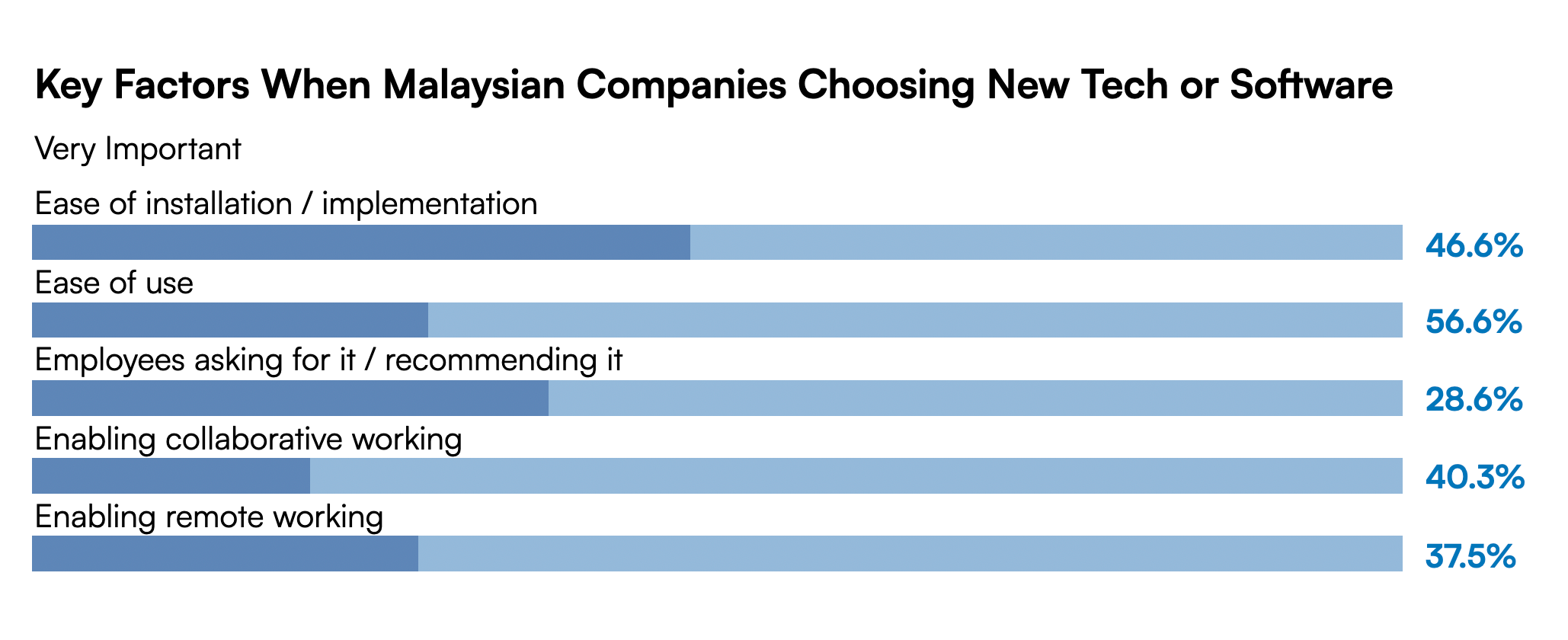
OpenMinds Group survey of 153 Malaysian executives, 2024: ease of use ranked as the primary factor in technology selection decisions.
The same survey found that only 28.9% of respondents were actively using AI tools in their work at the time. For context, that was before the generative AI adoption surge of 2024 to 2025. Current estimates put the figure higher, but the pattern remains: adoption is happening at the individual level before it becomes an organisational capability.
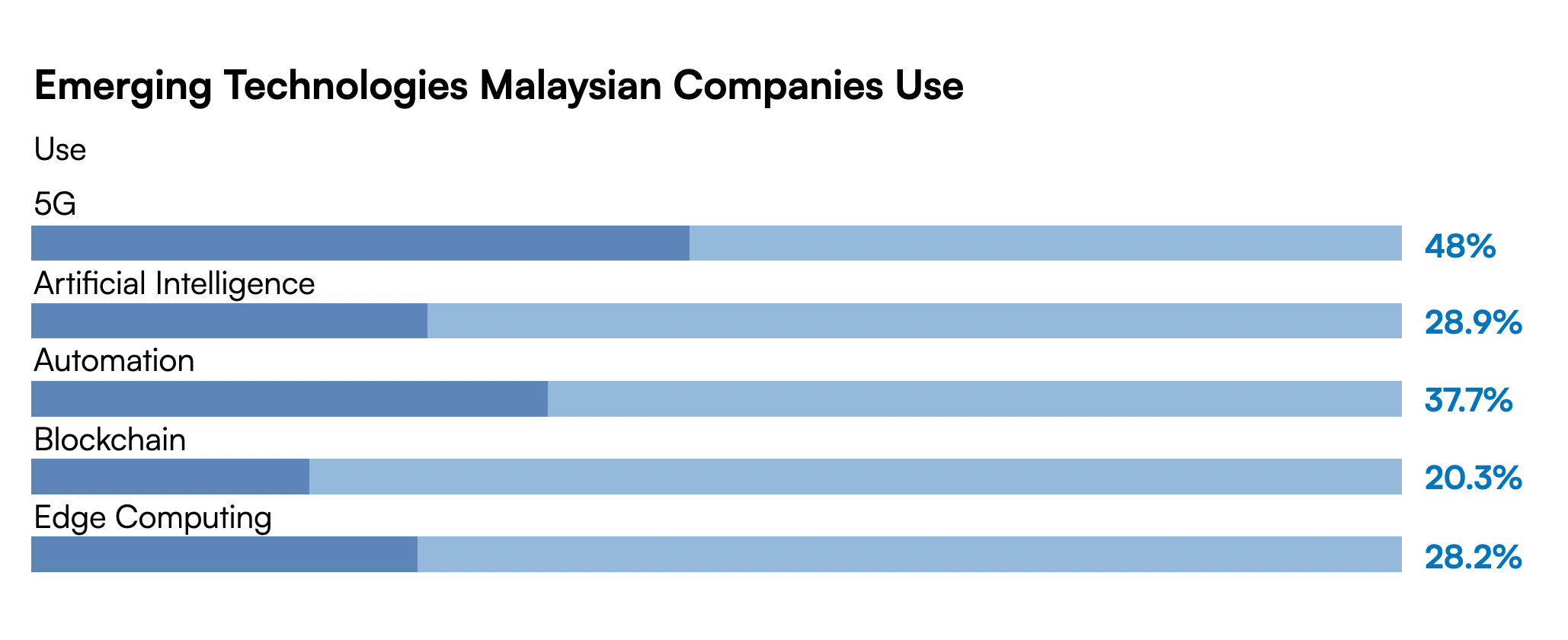
OpenMinds Group survey, 2024: technology adoption patterns across Malaysian enterprises, pre-2025 AI adoption surge.
The largest SME-facing grant programme is the Malaysia Digital (MD) programme under MDEC. Qualifying companies can access subsidised digital tools, cloud infrastructure credits, and co-investment for digital transformation projects. The SME Digitalisation Grant, offered in prior cycles, has been superseded by broader allocations under the Malaysia Digital Acceleration Grant in Budget 2026.
Budget 2026: What Was Allocated, Who Can Access It, and How
The headline allocation for the Malaysia Digital Acceleration Grant is RM53 million. That is modest relative to the RM163.6 billion in total digital investment approvals in 2024. Budget 2026’s value to SMEs is not in the grant amount itself. It is in the tax deduction for training. Most Malaysian businesses have not yet claimed it, and it requires no competitive application.
Budget 2026, tabled by Prime Minister Anwar Ibrahim in October 2025 under the MADANI framework, contained several significant digital economy allocations. The Ministry of Digital confirmed the following key items:
Targets adoption of emerging technologies: blockchain, artificial intelligence, and quantum computing. Administered through MDEC. Open to Malaysia Digital (MD) status companies. Application through the Malaysia Digital portal at mdec.my.
Funding for the NAIO’s expanded mandate in shaping Malaysia’s national AI governance and adoption policy. Not directly accessible to businesses, but directly shapes which AI frameworks and tools receive government endorsement and procurement priority.
The most immediately accessible allocation for Malaysian SMEs. MSMEs undertaking AI and cybersecurity training courses accredited by the MyMahir National AI Council for Industry (NAICI), TalentCorp, or MyDIGITAL qualify for an additional 50% tax deduction on training expenses. Standard deduction rules apply on top of this. The accredited provider list is available through TalentCorp and the MyDIGITAL portal.
Budget 2026 includes direction to MCMC to build sovereign AI infrastructure, protecting national data within Malaysian-controlled systems while enabling large-scale AI deployment. This affects data governance frameworks that businesses operating in regulated sectors (finance, healthcare, government contracts) will need to align with through 2026 and 2027.
Budget 2026 digital allocations: Ministry of Digital Malaysia, October 2025; Bernama, Budget 2026 Digital Initiatives, October 2025; MyDIGITAL Corporation, October 2025.
Digital Minister Gobind Singh Deo, on Budget 2026 digital allocations, October 2025
The Next 90 Days: Specific Actions for Malaysian Businesses
Three tiers of businesses face different priorities based on where they are in the digitalisation curve.
For SMEs not yet on any digital programme
The immediate action is applying for Malaysia Digital (MD) status through MDEC. This is the prerequisite to access most government-linked grants and programmes. The application is online and most qualifying businesses operating in digital services, technology, or digitally enabled sectors, can obtain MD status within weeks. Without it, the Budget 2026 grant programmes are inaccessible.
For businesses already operational digitally but not yet leveraging AI tools
The 50% additional tax deduction for accredited AI training is the lowest-effort, highest-certainty win available in 2026. A business spending RM20,000 on NAICI-accredited AI training this financial year captures an immediate tax benefit before any productivity gain from the training itself. The payback on certified AI training is front-loaded in a way that most digital investments are not. Check the accredited provider list on the TalentCorp and MyDIGITAL portals before booking any training.
For enterprises already running AI in specific workflows
The data sovereignty question matters now, not later. Budget 2026’s sovereign AI infrastructure directive signals that data governance requirements for companies handling regulated data will tighten through 2026. Financial services, healthcare, and companies with government contracts should review their cloud and AI data residency arrangements against the emerging NAIO guidelines before mandatory compliance creates a scramble. Setting data governance policy proactively is cheaper than retrofitting it under deadline.
Malaysia’s digitalisation challenge in 2026 is not access to tools, funding, or infrastructure. All three exist and are growing fast. The challenge is the gap between what businesses sign up for and what they actually implement at depth. An MSME that takes a digitalisation grant to set up an online storefront and then continues running internal operations manually has not digitalised. It has added a digital front door to an analogue operation. The next phase of Malaysian digitalisation is the inside of businesses, not the outside.
Where Malaysia Stands: A Progress Summary
| Area | Current status | Target / direction | Assessment |
|---|---|---|---|
| 5G coverage | 82.4% populated areas (DNB) | U Mobile targeting +80% by H2 2026 | On track, speed issues unresolved |
| Digital economy GDP contribution | 22.6% reported baseline (2021) | 25.5% by end 2025; 27% by 2026 | Acceleration needed to hit target |
| SME e-commerce adoption | 725,285 MSMEs (2025) | 875,000 target (MyDIGITAL) | Near-target on volume, depth gap persists |
| SME AI adoption | 12% (2024, MDEC) | 28-35% projected by 2026 | Tracking upward; depth quality uncertain |
| Data centre capacity | 690 MW by mid-2025 (from 120 MW in 2023) | Southeast Asia’s leading hub | Achieved; power sustainability is next constraint |
| Digital investment | RM163.6B approved (2024, +250% YoY) | Continued large-scale FDI via JS-SEZ | Exceeding expectations |
Compiled from: MDEC investment data; Digital in Asia; Tech Wire Asia; Industry Chatter; MyDIGITAL Corporation reports.
Building a digital strategy around Malaysia’s 2026 landscape?
OpenMinds Group works with Malaysian brands and enterprises to translate these shifts into actual execution: from digital infrastructure audit to AI adoption roadmaps and Budget 2026 grant access.