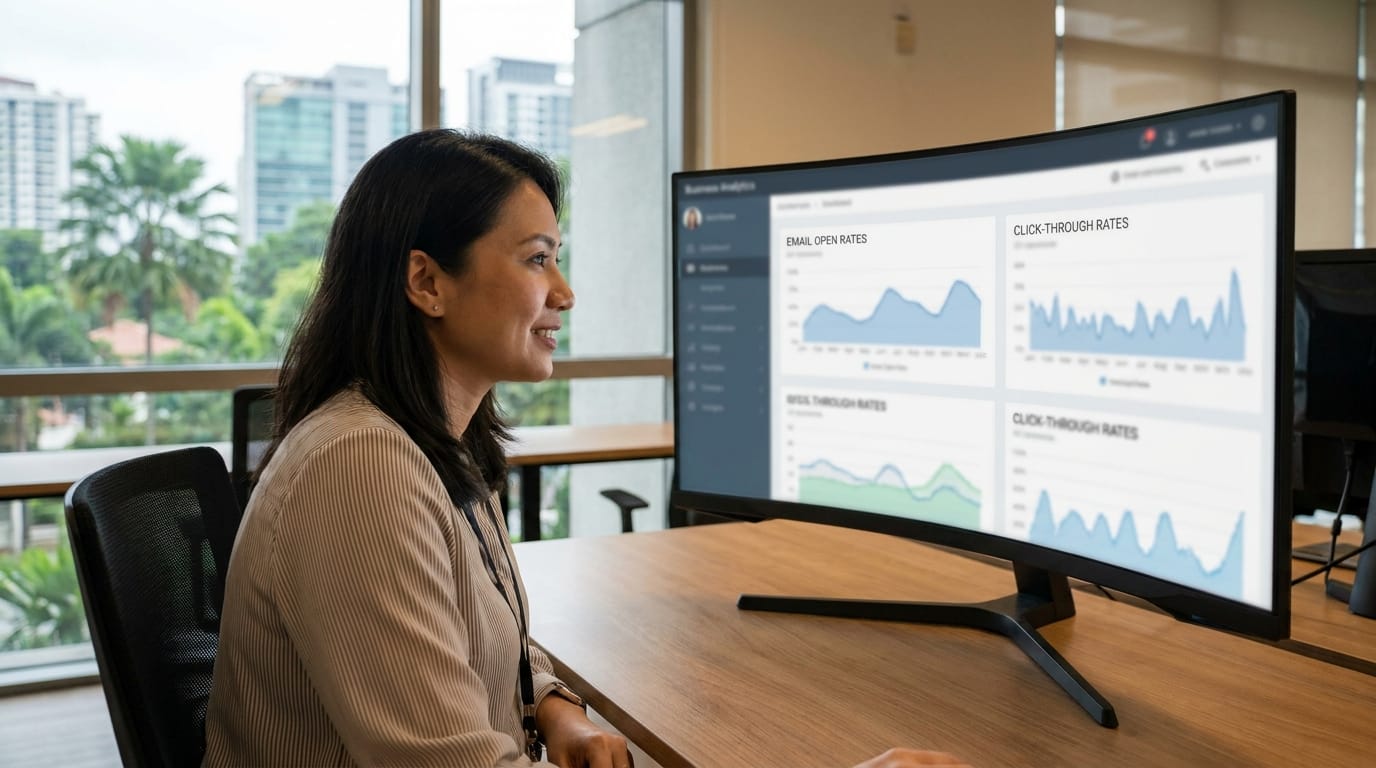
- Average Open Rate: The average email open rate across all industries in Malaysia is 21.33%. A “good” rate falls between 17% and 28%, varying significantly by sector.
- Return on Investment (ROI): Email marketing delivers an average return of RM170 to RM200 for every RM1 spent, making it one of the most effective digital channels for Malaysian businesses.
- Industry Variance: Professional services see the highest open rates (25. 35%), while retail and e-commerce are typically lower (15. 22%) due to higher send frequency and competition.
- Local Context is Critical: Malaysian benchmarks are lower than global averages (like the 55.4% US rate) due to a mobile-first audience and high inbox competition from apps like WhatsApp.
For 2026, the most critical email marketing benchmarks Malaysia-based businesses should track show an average open rate of 21.33% and a powerful return on investment between RM170 and RM200 for every RM1 spent. A “good” open rate is not a single number but a range from 17% to 28%, depending heavily on the specific industry and audience engagement.
These figures highlight a crucial reality for local marketers: benchmarking against global averages is a recipe for misaligned expectations. The Malaysian digital landscape, dominated by mobile usage and high engagement on messaging apps, creates a unique inbox environment. Success requires a strategy grounded in local data, not international reports.
Why Malaysian Benchmarks Differ from Global Averages
It is common for marketers to see global email open rates reported as high as 55.4% and feel their own performance is lacking. However, the Malaysian context is fundamentally different. The local average of 21.33% is a healthy and realistic figure when considering several factors.
First, Malaysia is a mobile-first nation, with over 90% of users accessing email on smartphones. This behaviour favours short, scannable content and makes long-form newsletters less effective. Second, WhatsApp is the primary communication channel, meaning email must compete for attention in a way it does not in Western markets.
This saturation naturally lowers open rates but places a higher value on the attention a business does earn.
Malaysia Email Marketing Benchmarks 2026 by Industry
Performance metrics are not one-size-fits-all. A campaign for a professional services firm will have different engagement patterns than a flash sale announcement from a fashion retailer. The table below provides a clear breakdown of average rates across key Malaysian industries.
| Industry | Avg Open Rate (Malaysia) | Avg Click Rate (Malaysia) | Unsubscribe Rate | Best Send Time |
|---|---|---|---|---|
| Professional Services / Healthcare | 25. 35% | 8. 12% | 0.10. 0.15% | 10 AM. 12 PM |
| Retail / Fashion | 15. 22% | 10. 14% | 0.15. 0.20% | 11 AM. 1 PM |
| E-commerce | 15. 22% | 12. 16% | 0.18. 0.22% | 2 PM. 4 PM |
| Finance / Business | 20. 28% | 6. 10% | 0.12. 0.16% | 10 AM. 12 PM |
| Education | 22. 30% | 8. 12% | 0.14. 0.18% | 2 PM. 4 PM |
| F&B | 18. 25% | 11. 15% | 0.16. 0.20% | 11 AM. 1 PM |
| Global Average (for context) | 55.4% | 3.7% | 0.14% | Varies |
Use this data as a starting point. If a business’s rates are significantly below these figures, it signals an opportunity for optimisation. If they are at or above, the focus should be on maintaining quality and segmenting for even better results.
Define ‘Good’ for Key Email Metrics
Beyond industry averages, it is vital to understand the health of each specific metric.
Email Open Rate Malaysia
The open rate is the percentage of recipients who opened an email. It is a primary indicator of subject line effectiveness and brand recognition.
- Needs Fixing: Below 15%
- Average: 17%. 28%
- Strong: Above 30%
Click-Through Rate (CTR) Malaysia
CTR measures the percentage of recipients who clicked on a link within the email. It reflects the relevance and appeal of the email’s content and call-to-action.
- Needs Fixing: Below 5%
- Average: 6%. 12%
- Strong: Above 14%
Unsubscribe Rate
This tracks the percentage of recipients who opt out. A low rate indicates a healthy, engaged list.
- Healthy: 0.10%. 0.22%
- Warning Sign: Above 0.3%
- Critical: Above 0.5% (This may indicate list quality issues or content mismatch).
Drive Performance with Localised Tactics
Achieving strong email marketing benchmarks in Malaysia for 2026 depends on tactics tailored to local behaviour. Global best practices often fall short.
1. Craft Subject Lines for Malaysian Inboxes
Personalisation is effective. Including a recipient’s name in the subject line can lift open rates from 15.70% to 18.30%. However, combining personalisation with local language elements achieves an even better open rate of 28.5%. Keep subject lines concise (30. 50 characters) to avoid being cut off on mobile screens.
2. Segment Lists for Deeper Relevance
While simple personalisation helps, deep segmentation delivers superior results. A Malaysian D2C fashion retailer that segmented its lists by purchase history and demographics saw open rates climb to 32.0%. This proves that sending highly relevant content to a smaller, targeted group is more effective than sending a generic message to everyone.
Start with simple segments like new customers, repeat buyers, and inactive subscribers. Tailor offers and content to each group’s relationship with the brand.
3. Optimise Send Times for Local Audiences
Timing matters. As the benchmark table shows, different industries see peak engagement at different times.
- F&B and Retail: Target the 11 AM. 1 PM lunch window.
- E-commerce: The 2 PM. 4 PM afternoon slot often captures shoppers planning evening purchases.
- B2B / Professional Services: The 10 AM. 12 PM morning focus time is most effective.
Test these windows and analyse the results to find the sweet spot for a specific audience.
Measure the Real ROI of Email Marketing
Ultimately, email marketing is a commercial tool. The most important benchmark is its return on investment. my/email-marketing-malaysia-2026/) spent.
This makes it a highly efficient channel for driving revenue, especially for SMEs and D2C brands.
To track this, organisations must connect their email platform to their e-commerce or CRM system. This allows for direct attribution of sales to specific campaigns. my/email-marketing-malaysia-2026/) more revenue on average than those who do not.
This statistic alone validates the channel’s importance in any digital strategy.
Improving email performance begins with understanding what is realistically achievable in the local market. By using these email marketing benchmarks for Malaysia in 2026 as a guide, businesses can set informed goals, diagnose issues, and implement strategies that resonate with a Malaysian audience.
The core principle is simple: relevance drives results, and local data defines relevance.
For a deeper analysis of how these benchmarks apply to a specific business model, contact our team.
See how this works in practice in our OpenMinds case studies.
Sources
- Fixgure: “Email Marketing Malaysia 2026” (2026)
- Martech: “Email Marketing Strategies That Work in Malaysia 2026” (2026)
- Dotdigital: “Global Benchmark Report 2026” (2026)
Want to put this into practice?
Our team builds and optimises MarTech stacks for enterprise brands across Malaysia and APAC.