
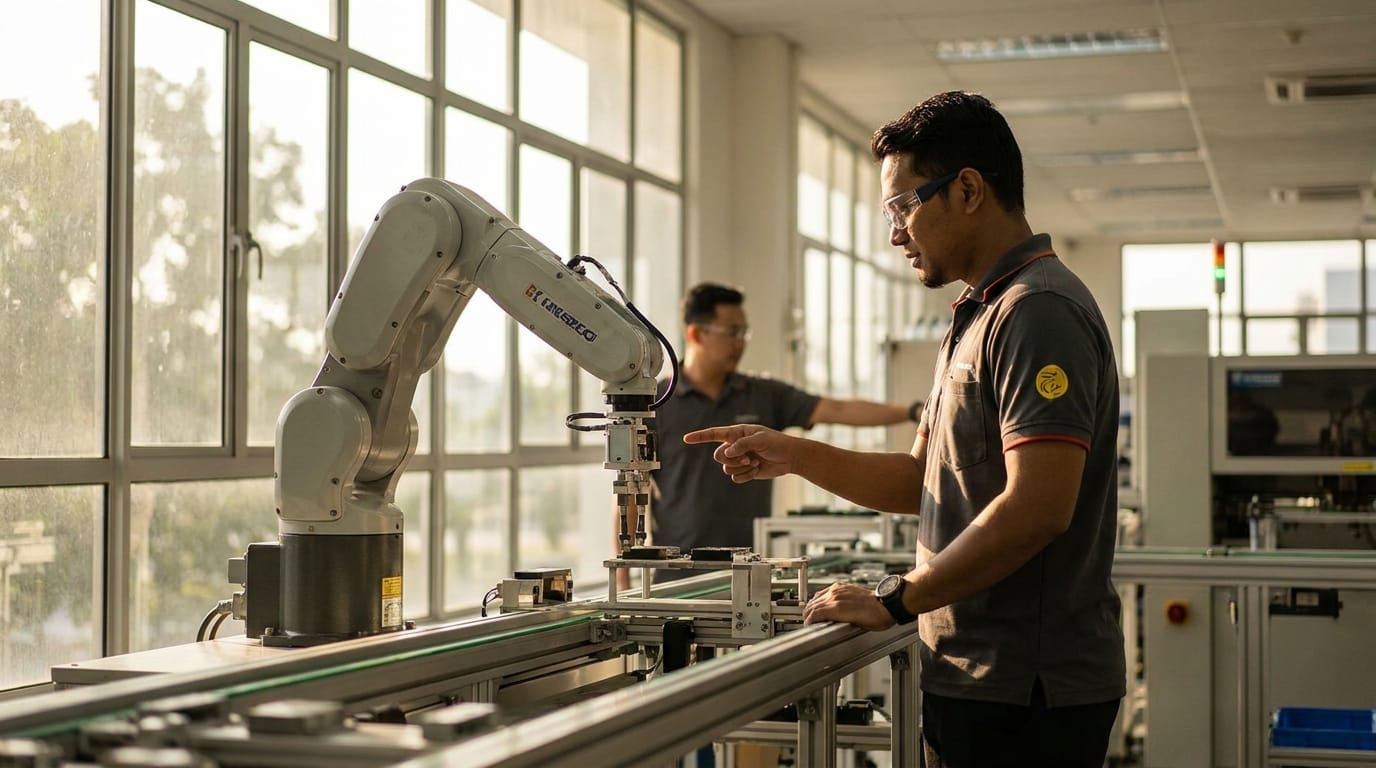
- The national Industry4WRD policy uses a mandatory Readiness Assessment (RA) as a gateway for SMEs to access key financial incentives.
- Funding is not the primary barrier. The greater challenge for many Malaysian manufacturers lies in data integration, system modernisation, and workforce upskilling.
- A diverse range of government support is available, including matching grants, soft loans, and capital allowances, each designed for different stages of adoption.
- Successful digitalisation requires a phased roadmap that moves from targeted pilots in high-impact areas to a fully integrated smart factory model.
The conversation around manufacturing digitalization in Malaysia has matured significantly. It has shifted from a theoretical discussion about Industry 4.0 to a practical imperative for competitiveness, driven by national policies and tangible investment from global players.
For enterprise leaders, the challenge is no longer about whether to digitalise, but how to do it strategically. This involves moving beyond isolated technology purchases and building an integrated ecosystem that connects the shop floor to the top floor, optimising processes and unlocking new value.
Assess Your Industry4WRD Readiness
The cornerstone of Malaysia’s approach is the Industry4WRD national policy. A critical first step for any SME seeking government support is the Readiness Assessment (RA), a programme designed to help firms identify gaps and prioritise digital investments.
The government has actively supported this initial stage. It has funded the RA for 500 SMEs and offers a tax deduction of up to RM27,000 for assessment expenditures, making it an accessible entry point for evaluating operational maturity.
Prioritise High-Impact Automation
Automation remains a key enabler of digitalisation. According to the Malaysian Investment Development Authority (MIDA), the number of local companies focused on factory automation has doubled since 2010, reflecting a clear market trend.
Successful firms begin with targeted automation projects that promise the clearest return on investment. These typically involve processes that are repetitive, labour-intensive, or highly sensitive to quality control. This approach builds internal confidence and generates early wins to justify further investment.
Navigate the Funding Landscape
Malaysia offers a comprehensive suite of financial incentives to lower the capital barriers to entry. However, these are not one-size-fits-all solutions. Leaders must match the right instrument to their specific needs and stage of transformation.
The government has structured support to cover different aspects of the digitalisation journey, from initial assessment to large-scale capital expenditure. Understanding these options is crucial for building a viable business case.
| Incentive Type | Description | Best For |
|---|---|---|
| Matching Grants | Government co-funds a percentage of project costs, such as the 70:30 MIDA grant up to RM500,000. | Pilot projects, technology trials, initial system upgrades. |
| Soft Loans | Favourable financing terms for automation and modernisation (e.g., SLAM). | Significant capital investments in machinery and equipment. |
| Capital Allowances | Accelerated tax relief on qualifying capital expenditure, with a 200% allowance on the first RM2-4 million depending on industry. | Companies with taxable profits looking to offset large capex. |
| Tax Deductions | Direct deductions for specific activities, like the RM27,000 deduction for Readiness Assessments. | The initial assessment and planning phase of digitalisation. |
Matching Grants and Soft Loans
For SMEs that have completed the RA, several funding paths open up. MIDA provides intervention funding with a 70:30 matching grant for at least 60 SMEs, while MDEC’s Digital Transformation Acceleration Program offers a 1:1 matching grant for pilot projects. For larger investments, the Soft Loan Scheme for Automation & Modernisation (SLAM) provides critical financing.
Capital Allowances and Tax Deductions
To encourage more substantial investment, the Automation Capital Allowance provides a 200% allowance on the first RM2 to RM4 million of expenditure incurred within five years, depending on the industry. This significantly reduces the tax burden associated with major equipment upgrades.
Move Beyond Equipment Purchase
A common pitfall is viewing manufacturing digitalization in Malaysia as a simple exercise in acquiring new machinery. The real, sustained value comes from integration. Research shows that many firms remain in preliminary phases, held back by challenges in data management and system integration.
A smart factory is not just a collection of robots. It is a connected environment where data from IoT sensors, production lines, and Enterprise Resource Planning (ERP) systems flow into a central hub for real-time analysis and decision-making.
Prioritise modernising your Manufacturing Execution System (MES) and ERP integration before investing heavily in new shop-floor hardware. A solid data foundation is non-negotiable.
Build a Phased Digital Roadmap
Instead of attempting a complete overhaul at once, effective leaders build a sequential roadmap for their digital factory. This approach de-risks the transformation and ensures each step is validated.
Pilot: Identify a single, high-pain-point production line or process. Implement a targeted solution (e.g., predictive maintenance on a critical machine) and measure the impact.
Scale: Take the learnings from the successful pilot and replicate the solution across similar lines or processes in the plant. Standardise the technology and operating procedures.
Integrate: Connect scaled solutions into a unified data platform. This is the stage where a true digital factory emerges, enabling plant-wide visibility and optimisation.
Develop a Skilled Workforce
Technology alone cannot deliver results. The final piece of the puzzle is human capital. As automation and data analytics become central to operations, roles on the factory floor will evolve.
Organisations must invest in upskilling programmes for line workers, technicians, and managers. Training should focus on human-machine collaboration, data interpretation, and problem-solving in a digital environment. Without this, even the most advanced technology will underperform.
Conclusion
The journey of manufacturing digitalization in Malaysia is well underway, supported by a robust policy framework and a clear economic need. For leaders, success depends less on the technology itself and more on the strategic thinking that guides its implementation. The focus must be on integration, data readiness, and workforce development.
The goal is not just to buy technology, but to build a connected, intelligent, and resilient manufacturing ecosystem.
A well-defined strategy is essential for this transformation. If your organisation is planning its next steps in Industry 4.0, contact our team to discuss how to build a practical and impactful roadmap.
Sources
- MIDA – A report on automation as a key enabler for manufacturing digitalisation in Malaysia
- Asia School of Business – A 2024 policy paper on Industry 4.0 technology adoption in Malaysian manufacturing SMEs
- ScienceDirect – An academic study on the current practices and challenges of Industry 4.0 in Malaysian manufacturing firms
Want to put this into practice?
Our team builds and optimises MarTech stacks for enterprise brands across Malaysia and APAC.