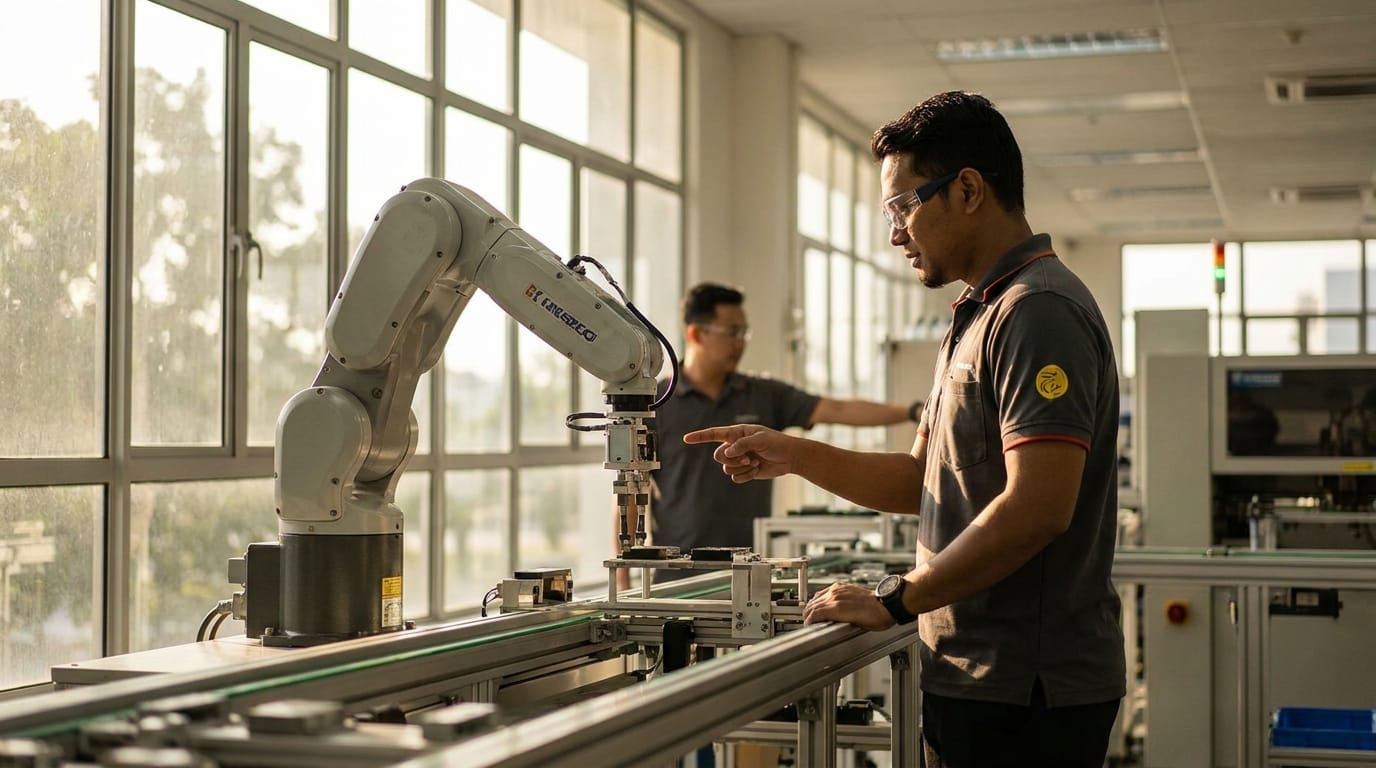
- Focus on One Problem: Successful digital transformation in Malaysia starts by fixing a single, high-impact operational bottleneck, not by attempting a complete business overhaul at once.
- Budget for People, Not Just Platforms: The most significant cost is often the two weeks of productivity dip while your team learns a new system, not the monthly software subscription.
- Leverage Government Support: Malaysian SMEs can access grants from RM5,000 to over RM100,000 for digitalisation and AI adoption through programmes like the MSME Madani Digital Grant.
- Pilot, Measure, Scale: Test any new technology on a small, measurable pilot project for 90 days to prove its ROI before committing to a company-wide rollout.
Digital transformation in Malaysia is a strategic shift for SMEs to adopt cloud tools, automate processes, and use data for decision-making. This shift is directly supported by 2026 government grants like the MSME Madani Digital Grant and AI adoption funds.
Success requires a phased, step-by-step approach. Many businesses fail by trying to digitise everything simultaneously instead of fixing one high-impact process first. This practical checklist provides a structured path for Malaysian SMEs to follow.
The 10-Step Digital Transformation Checklist
For any Malaysian SME, the journey begins not with buying software, but with understanding the business. This 10-step framework prioritises process over platform, ensuring technology serves a clear business goal.
Audit Current Processes: Map out your existing workflows, both digital and manual.
Identify the Biggest Bottleneck: Pinpoint the single process that wastes the most time or money.
Prioritise Impact: Decide if fixing a customer-facing issue (like sales) or an internal one (like invoicing) will deliver more value first.
Budget for Hidden Costs: Account for training time, potential downtime, and change management, not just subscription fees.
Choose Cloud Infrastructure: Select a foundational platform like Google Workspace or Microsoft 365.
Train the Team First: Conduct training sessions before the new tool goes live to reduce friction.
Automate One Process as a Pilot: Select a single, end-to-end workflow to automate as a test case.
Set Clear Pilot KPIs: Define what success looks like with specific metrics (e.g., reduce invoicing time by 50%).
Measure ROI After 90 Days: Honestly assess the pilot’s performance against your KPIs.
Scale What Works: If the pilot is successful, roll out the solution to other teams or processes.
Start with a Process Audit
Before considering any new technology, an SME must understand its current state. Document key business processes from sales and marketing to finance and operations. Identify which steps are manual, which use outdated software (like spreadsheets for accounting), and where information gets lost between departments.
This initial audit creates a map of inefficiencies. It moves the conversation from “we need a CRM” to “our sales team spends 10 hours a week manually updating customer details.” This problem-first approach is the foundation for any successful digital transformation in Malaysia.
Pinpoint One High-Impact Bottleneck
The most common mistake in technology adoption is trying to solve five problems at once. Companies that attempt a complete overhaul often finish none of their projects. The key is to identify the single biggest point of friction in the business and focus all initial energy there.
Ask your team, “If you could eliminate one repetitive, manual task from your daily work, what would it be?” The answer often points directly to the most valuable process to digitise first. This could be anything from managing inventory to scheduling appointments or generating invoices.
Budget Realistically for Your Transformation
A digital transformation budget must extend beyond the monthly subscription fee. The most significant, and often overlooked, expense is the cost of change management and training. The real cost is the two weeks teams spend learning new tools while trying to maintain their normal workload.
Factor in these hidden costs:
- Training: The cost of formal training sessions or the time senior staff spend coaching others.
- Productivity Dip: A temporary decrease in output as employees adapt to new workflows.
- Integration: Potential costs for connecting the new tool to existing systems.
Select the Right Cloud Foundation
For most Malaysian SMEs, the choice between Google Workspace and Microsoft 365 is a foundational decision. These platforms provide the core communication, collaboration, and storage tools upon which other applications will be built. The choice depends entirely on how a team works.
| Feature | Microsoft 365 | Google Workspace |
|---|---|---|
| Best For | Businesses needing deep Excel/Word integration & Teams | SMEs needing seamless web-based collaboration & Chrome ecosystem |
| Communication | Desktop-heavy Teams app | Browser-first Gmail & Chat |
| Storage | 1TB per user (varies) | 2TB to 5TB per user (varies) |
| Cost Efficiency | Higher for desktop-heavy users | Lower for web-based startups |
| Training Overhead | Higher (complex desktop apps) | Lower (web-native simplicity) |
Launch and Measure a Pilot Project
Instead of a high-risk, company-wide launch, test new technology with a small, controlled pilot project. Choose one department or one specific workflow and implement the new tool for a 90-day period. This approach limits disruption and provides concrete data on the tool’s effectiveness.
Set Clear KPIs for the Pilot
Define what success looks like before the pilot begins. Vague goals like “improve efficiency” are not measurable. Instead, set specific Key Performance Indicators (KPIs).
- Time Saved: Reduce time spent on manual invoicing from 4 hours to 1 hour per week.
- Error Reduction: Decrease data entry errors in customer orders by 90%.
- Increased Capacity: Enable one person to manage 50% more customer support tickets.
Measure ROI Honestly
After 90 days, analyse the results against your KPIs. Did the tool deliver the expected value? Was the cost in time and money worth the outcome? This data-driven judgement determines whether to scale the solution, try a different tool, or abandon the initiative.
Secure Your Digitalisation Grant Malaysia
The Malaysian government actively supports MSME digitalisation through various grants and incentives. These funds can significantly lower the financial barrier to technology adoption. For the wider national picture, see our full report on where digitalization in Malaysia actually stands in 2026. To be eligible, businesses typically need to be at least 60% Malaysian-owned, have been operating for over a year, and have valid SSM registration.
Always apply for the grant before selecting and paying a vendor. Most programmes, like the MSME Madani Digital Grant, require you to work with an approved Technology Service Provider from the MDEC list.
| Grant Type | Max Amount | Eligible Owner | Key Requirement |
|---|---|---|---|
| MSME Madani Digital Grant | Up to RM5,000 | 60%+ Malaysian | MDEC-registered Digitalisation Partner |
| SME Digitalisation & AI Grant | RM5,000 to RM100,000+ | 60%+ Malaysian | SSM registration, |
| HRDF Levy Claim | Varies (training costs) | Any registered SME | SBL-Khas claimable courses |
For example, a boutique firm like Virtual SME used a digitalisation grant to implement a CRM and then claimed from the HRDF levy to train its sales team on the new system. This stacked approach maximises government support.
Scale What Works, Ditch What Fails
The final step is to act on the pilot project’s results. If the new tool successfully met its KPIs and delivered a clear return on investment, create a plan to roll it out to other relevant teams or processes. If it failed, analyse why and use those lessons for the next attempt.
This iterative cycle of piloting, measuring, and scaling is the engine of a sustainable digital transformation. It replaces guesswork with evidence, ensuring every technology investment is tied to a proven business outcome.
Digital transformation is not a one-time project but a continuous process of improvement. By following a structured, problem-focused approach, Malaysian SMEs can adopt the right technology to grow efficiently and compete effectively.
The core principle is simple: Digital transformation is a series of small, measured steps, not one giant leap.
To navigate the complexities of technology adoption in Malaysia, contact our team for strategic guidance.
See how this works in practice in our OpenMinds case studies.
Sources
- Gotchaa Lab: “Digital transformation for Malaysian SMEs: a practical guide for 2026 …” (2026)
- Corporatetrainingmalaysia: “SME Digitalisation & AI Grant Malaysia 2026 — How to Apply” (2026)
- Etddigital: “SME Digitalisation Grant Malaysia 2026 – ETD Digital” (2026)
- Bigbang360: “Digital Transformation Strategies for SMEs in 2026 – Big Bang ERP” (2025)
- Digitransformationsummit: “Digital Transformation Summit Malaysia 2027 | Tech Event” (2026)
- Mdec: “mdec.my”
Want to put this into practice?
Our team builds and optimises MarTech stacks for enterprise brands across Malaysia and APAC.